


As a core project of China's second batch of large-scale wind and photovoltaic bases in deserts, the Gobi, and other arid regions, and the world's largest single-phase integrated “solar thermal + storage” project, the ENERGY CHINA Hami “Photovoltaic (Thermal) + Storage” 1500 MW Multi-Energy Complementary Integrated Green Power Demonstration Project — after two and a half years of arduous effort — has completed installation of all core equipment and fully entered the commissioning phase. It is now making a final push toward the goal of first-phase grid connection and power generation by the end of the year. Standing in the wind zone of the Gobi, this iconic project, with the resolve to “blaze trails through mountains and bridge rivers,” is injecting green momentum into the building of a new-type power system and the safeguarding of national energy security.
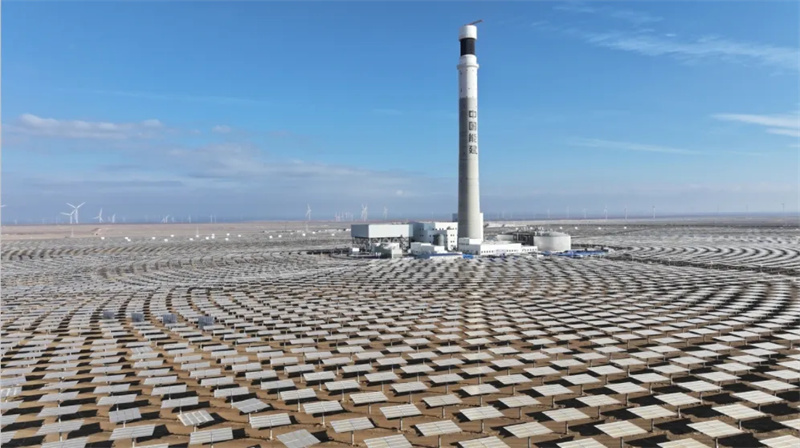
Caption: The world's largest integrated “solar thermal + storage” project enters its final sprint. Photo by Guo Ziyi, Hami City Convergence Media Center
On October 23, in the central control room of the ENERGY CHINA Hami project, located in the Chahauquan area of Santanghu, Balikun, staff were carrying out data debugging ahead of the startup of the hot salt pump. The countdown sign reading “69 days to first grid connection” was particularly eye-catching.
The project site lies in a wind zone, a typical alpine desert area. With winter approaching, extreme low temperatures and frequent strong winds have become two “critical barriers” that must be overcome before year-end grid connection. Low temperatures can freeze water remaining in equipment pipelines, and once wind speeds exceed level 6, all 24,000-plus heliostats must switch into wind-resistance mode, forcing commissioning work to a halt.
Racing against harsh weather requires scientific coordination and meticulous management. Calculations show that of the 75 days remaining until the end of the year, about 30 will be affected by weather, leaving only 40 days of effective working time. The construction team has worked backward from the deadline, breaking commissioning tasks down to each day, and conducts special inspections and maintenance of equipment after high winds to ensure the entire heliostat field remains in intact standby condition. The main cylinder joint of the steam turbine has been completed, and pressure testing and heat tracing for the molten salt system are ready. Key milestones such as purge testing and molten salt melting are proceeding in an orderly manner according to plan.
Driving forward against the wind and tackling difficulties head-on is underpinned by clear goal orientation. Zhang Wei, general manager of the ENERGY CHINA Xinjiang Energy Development Co., Ltd. Hami Solar-Thermal-Storage Integrated Project, said that since official construction began in May 2024, all participating builders have endured two and a half years of hard struggle. Installation of equipment and pipelines for the solar thermal portion is now basically complete, with final finishing work such as insulation cladding under way; the melting of 27,600 tonnes of molten salt is about to begin; the photovoltaic portion is at the peak of its installation phase; and the goal of simultaneous grid connection of the solar thermal and photovoltaic units by year-end is becoming increasingly clear.
“Our confidence in ensuring grid connection and stable power transmission by year-end comes from the project's unique ‘two-way energy storage’ mechanism,” Zhang said. “The project has a total installed capacity of 1,500 MW, including 1,350 MW of photovoltaic and 150 MW of solar thermal. Through an intelligent dispatching system, the two energy sources complement each other's strengths: during the day or when winds are strong, the wind and photovoltaic units generate at full capacity while the solar thermal system stores energy; at night or when wind and solar output fall short, the stored molten salt can release heat to generate electricity at any time, forming a cross-complementary, mutually integrated operating state and achieving 24-hour continuous power generation.”
The project has basically achieved full-chain domestic production of equipment — from the heliostats of the concentrating solar power system to the hot and cold salt pumps and various valves — with a localization rate exceeding 95%, blazing a new path of independent development for China's solar thermal industry.
It is understood that upon completion, the project will generate 2.9 billion kilowatt-hours of electricity annually, save 868,000 tonnes of standard coal per year, and reduce CO₂ emissions by 2.256 million tonnes — an ecological benefit equivalent to planting 120 million trees — providing critical support for a power grid with a high proportion of renewable energy.
From a barren Gobi to an “energy oasis,” from reliance on imported equipment to a localization rate exceeding 95%, the Hami “solar thermal + storage” integrated project is making its final charge toward year-end grid connection with a determined, win-at-all-costs posture, writing a vivid chapter in China's green, low-carbon energy transition.