


On August 20, the 100MW linear Fresnel solar thermal project of the CTGR Xinjiang Hami Integrated Energy Demonstration Project, EPC contracted by CPECC Northwest, successfully completed its 14-day trial operation assessment. All operating parameters of the unit remained stable, and all assessment indicators met the design requirements.
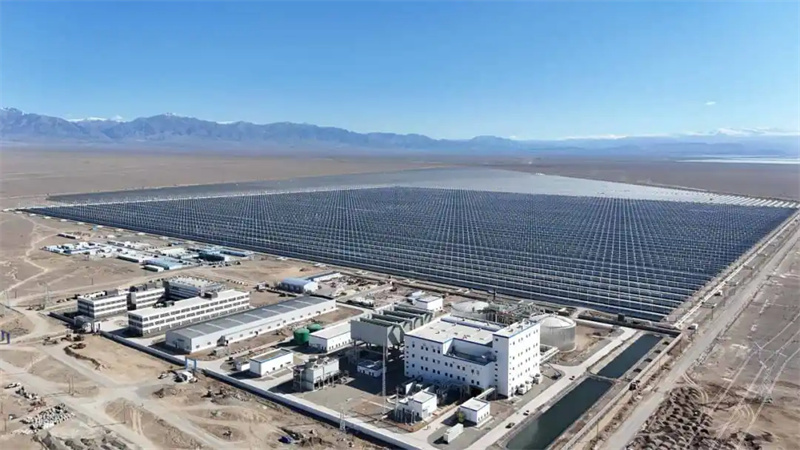
Aerial panoramic view of the CTGR Hami Linear Fresnel Solar Thermal Power Station
During the trial operation period, the project successfully completed the on-site testing and authoritative certification of China's first linear Fresnel CSP performance model software, successfully filling the technical gap in the field of full-system dynamic simulation for linear Fresnel solar thermal power stations in China.
The model was independently developed by CPECC Northwest, breaking through the limitations of existing simulation tools. It independently established a coupled iterative algorithm covering five major links: mirror field light concentration, heat exchanger heat transfer loss of the receiver, dynamic liquid level detection of molten salt storage tanks during charging and discharging, steam Rankine cycle power generation, and plant-wide auxiliary power consumption. It adopts double-precision floating-point hourly energy balance verification, simultaneously calculating light curtailment, remaining thermal storage capacity, and net power generation, achieving refined and digital simulation of the dynamic process of long-duration molten salt thermal storage.
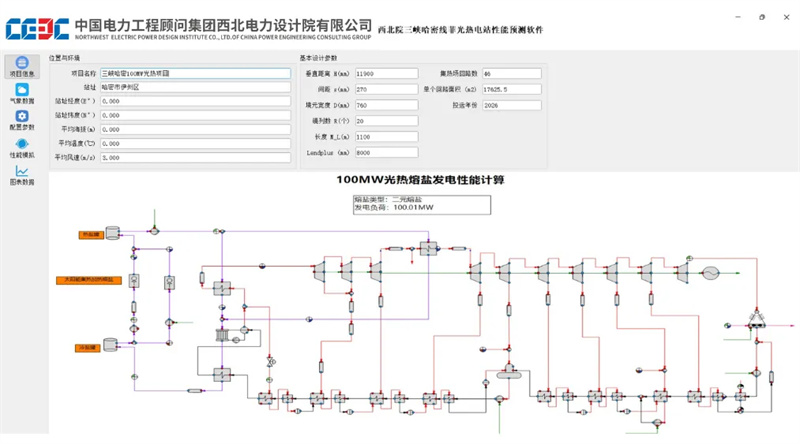
CPECC Northwest CTGR Hami Linear Fresnel Solar Thermal Power Station Performance Prediction Software
At the operational application level, the model constructs a full-process integrated visualization system, integrating five standardized front-end modules: project information, meteorological data import, equipment parameter configuration, performance simulation, and chart output. It supports graphical interactive operations and allows one-click switching among multi-period simulations including single-day, single-month, full-year 8,760-hour, and 25-year full lifecycle simulations. It automatically generates time-series curves and standardized reports, completely covering the business chain from engineering modeling to results delivery.
CPECC Northwest has established a fully independent performance model software system covering three mainstream technical routes: tower, trough, and linear Fresnel. It can run through all lifecycle stages including project development, theoretical calculation during the design phase, trial operation evaluation during the construction phase, power generation performance prediction during the operation phase, and post-project evaluation, providing quantitative support for technical decision-making at various stages of solar thermal power stations.
To date, CTGR Group has had two projects successfully pass the 14-day trial operation assessment. Compared with the first project, the construction period from commencement to passing the assessment for this project has been shortened by nearly one year, fully demonstrating the systematic maturity of the domestic solar thermal industry across the entire industrial chain, including engineering design, equipment manufacturing, construction commissioning, and operation management. This has accumulated valuable experience for subsequent large-scale solar thermal project construction in China.