


On June 15, at the new energy project site in Dalete Town, Bole City, Xinjiang, tens of thousands of heliostats spread across the desert in massive concentric circles, arranged in orderly rows around a central 220-meter-high solar receiver tower. Below the tower, construction vehicles shuttle back and forth, and workers are making final preparations for the molten salt charging process—the most critical and safety-intensive procedure in the project.
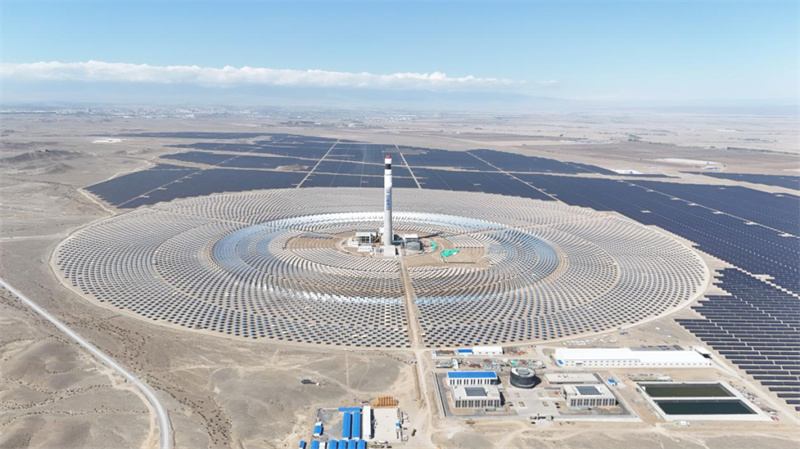
Bortala 100MW Thermal Storage CSP with 900MW New Energy Project Site.
As a key project under Xinjiang's second batch of market-oriented grid-connected new energy initiatives during the 14th Five-Year Plan period, the Bortala Mongol Autonomous Prefecture 100MW thermal storage concentrated solar power (CSP) project with 900MW of accompanying new energy is making an all-out sprint toward grid-connected power generation. The project is invested, constructed, and operated by Xinhua Botai (Bole) Power Investment Co., Ltd. (hereinafter referred to as Xinhua Botai), a subsidiary of China National Nuclear Corporation (CNNC).
Yang Bin, Deputy General Manager of Xinhua Botai, reported that in March this year, the project's hot molten salt tank achieved successful ignition for natural gas preheating in a single attempt. By June, critical milestones including pipeline pickling, receiver water circulation testing, and steam pipeline blowing had been completed. Currently, the CSP portion of the project has entered its final construction push. The upcoming molten salt charging operation represents the most technically challenging and highest-risk core procedure; once completed, full-system integrated commissioning will commence.
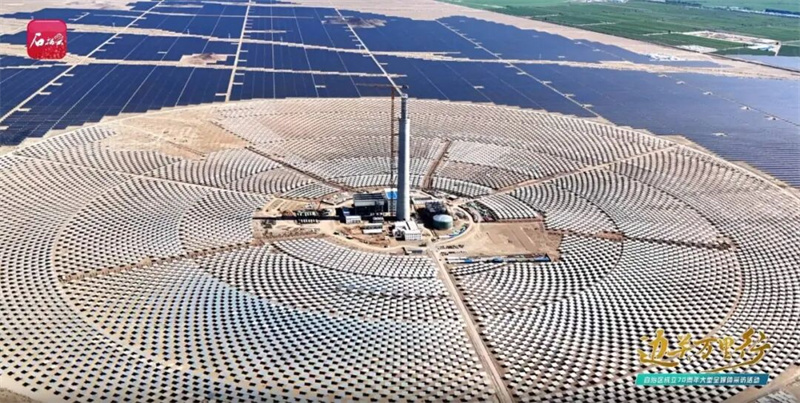
Jinghe 100MW CSP Project
Meanwhile, CNNC's 100MW CSP project in Jinghe County is also advancing steadily. The two base projects in Bole and Jinghe represent a total investment of 12.27 billion yuan, with a planned total installed capacity of 2,000MW, comprising 200MW of tower-type CSP and 1,800MW of photovoltaic (PV) power generation. To date, all 1,800MW of the PV capacity has been successfully connected to the grid. Upon completion, the two base projects are projected to generate 4.183 billion kWh of electricity annually, equivalent to saving approximately 1.4814 million tons of standard coal and reducing carbon dioxide emissions by approximately 3.7414 million tons each year.
To address the operational safety challenges faced by tower CSP receivers during sudden weather changes, the project team developed an intelligent forecasting system. By deploying all-sky imagers and ground-based cloud radars across the site, combined with meteorological satellite data, the system can predict cloud movement directions 5 to 15 minutes in advance, dynamically adjusting heliostat field control strategies to shift equipment from "passively enduring risks" to "actively mitigating hazards."
Yang stated that the project team will continue to advance technological breakthroughs in predictive equipment maintenance, digital twin modeling for molten salt thermal storage, and wireless communication for the solar field, further enhancing power plant operational efficiency and reliability to empower the high-quality development of Xinjiang's new energy industry.