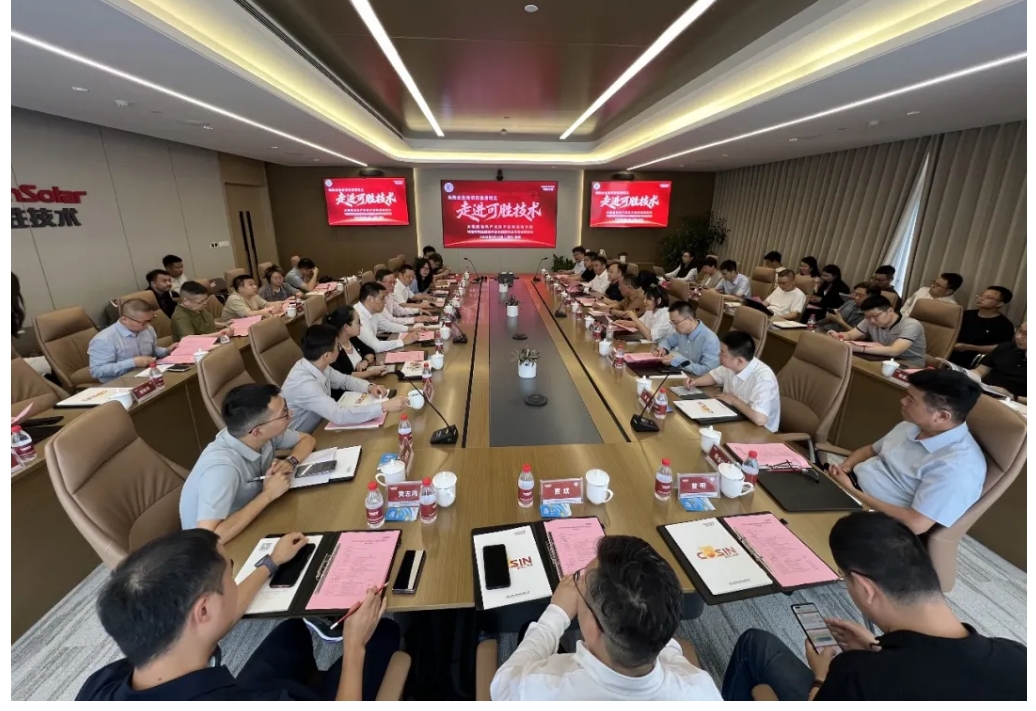
On May 12, the China Solar Thermal Alliance (hereinafter referred to as "CSTA") and the Solar Thermal Power Committee of Chinese Renewable Energy Society
jointly organized a visit to Cosin Solar Technology Co., Ltd. (Cosin Solar) and a thematic symposium on the scaled development path of CSP and industry chain collaboration, which was successfully held in Hangzhou.
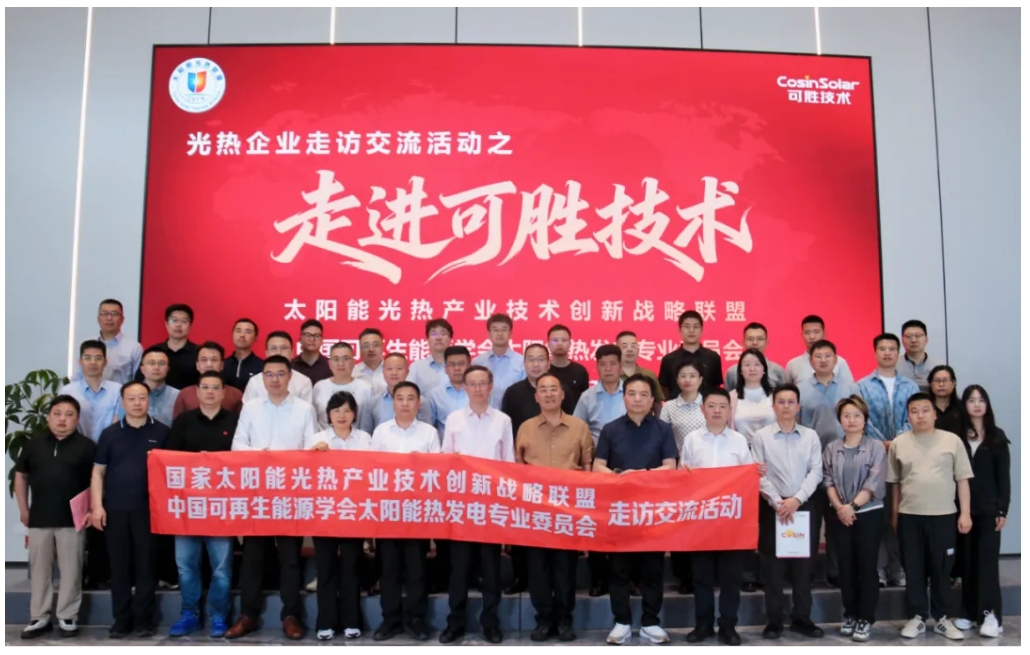
This conference brought together over 50 industry representatives from upstream and downstream sectors of the CSP field, including material and equipment supply, engineering design, and technology research and development. The participants engaged in in-depth exchanges and discussions on key topics such as the current policy background for CSP, project implementation, core technology innovation, cost reduction and efficiency improvement, and collaborative industry chain development. The conference further consolidated industry development consensus and jointly promoted China's CSP industry toward a new stage of high-quality, scaled development.
At the beginning of the event, representatives first visited Cosin Solar's corporate exhibition hall. Through the detailed explanations of the guide, participants systematically learned about Cosin Solar's technological research and development achievements, engineering application performance, and profound industrial foundation in core fields such as tower CSP and molten salt storage.
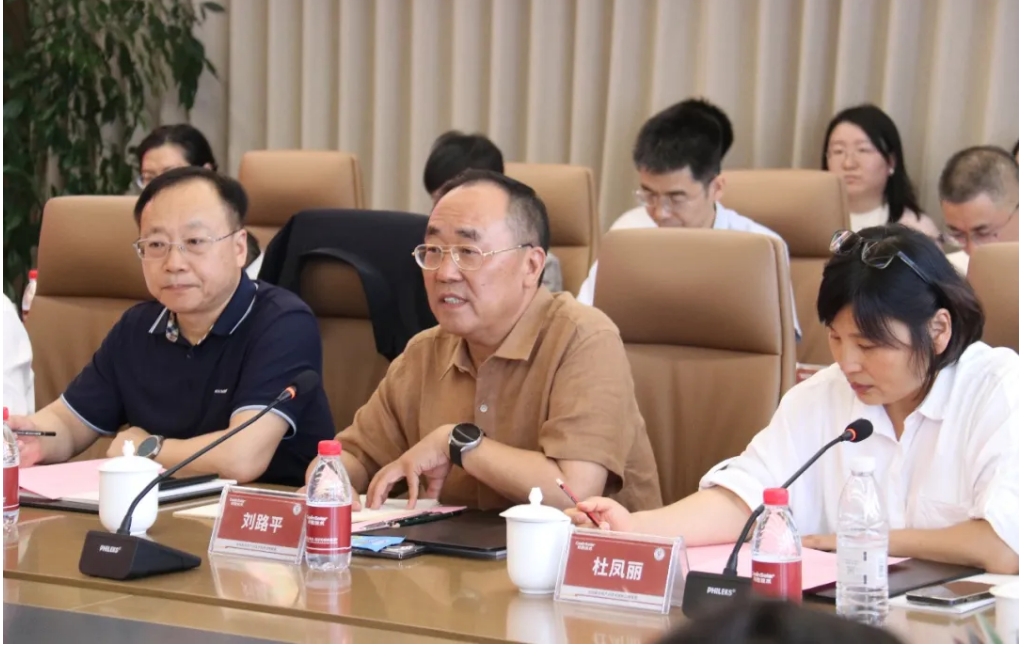
The symposium was chaired by Du Fengli, Secretary-General of the CSTA and the Solar Thermal Power Committee of Chinese Renewable Energy Society. Du Fengli first expressed sincere gratitude to Cosin Solar for its meticulous preparation and warm hospitality. She stated that this enterprise visit organized by the CSTA comes at a critical window period for industry development, carrying significant meaning and perfect timing. It aims to build a high-level, high-value, and results-oriented industry exchange and docking platform, effectively facilitating communication channels between upstream and downstream of the industry chain, and empowering all parties to deepen docking and cooperation.
Xu Neng, President and Chief Engineer of Cosin Solar, warmly welcomed the participating representatives and expressed sincere gratitude to the CSTA for its long-standing support. Xu Neng pointed out that China's solar thermal industry has entered a golden opportunity period for scaled development, with continuously optimized policy environment, ever-expanding market space, and increasingly prominent industrial value. Collaborative innovation and cost reduction through efficiency improvement are the core directions of industry development. This exchange and symposium precisely aligns with industry development needs, providing important support for the industry to build consensus, solve challenges, and advance collaboratively. Cosin Solar has been deeply engaged in the solar thermal field for sixteen years, adhering to independent innovation and research and development, possessing core technology and service capabilities across the entire industry chain. In the future, it will adopt an open and cooperative posture to deeply collaborate with partners across the entire industry chain, leveraging technical strength and industrial commitment to promote the scaled and high-quality development of the solar thermal industry.
Liu Luping, Vice Chairman of the CSTA, shared industry development insights and practical reflections in his address. He proposed that key projects should be used as a lever to drive overall quality upgrading of the solar thermal industry. In conjunction with relevant policies such as Document No. 1645, CSP possesses unique core advantages in power system regulation and the construction of new-type power systems. From the perspective of industry development trends, the grid-supporting capability of CSP continues to strengthen, and the levelized cost of electricity is steadily declining. Policy support and scale effects are the key driving forces for cost reduction, while technological innovation injects lasting momentum into sustainable industry development. Meanwhile, Liu Luping analyzed differentiated development paths under varying regional resource endowments and market conditions, drawing on practical experiences of solar thermal industry development in western provinces and regions. He looked forward to industry experts sharing cutting-edge perspectives on topics such as scaled development of solar thermal and policy orientation.
Jin Jianxiang, Chairman and Chief Scientist of Cosin Solar, Vice Chairman of the Solar Thermal Power Committee of Chinese Renewable Energy Society, and Professor at Zhejiang University, delivered a thematic report systematically elaborating on the technical advantages, industrial status, policy environment, and cost reduction implementation paths of CSP. From a technical perspective, CSP is an ideal choice for high-proportion new energy power systems. Taking Qinghai as an example, he explained why solar thermal has experienced explosive growth—CSP employs synchronous generator units, offering green, low-carbon characteristics and superior regulation performance, which aligns with Qinghai's demand for regulating and supporting power sources. Large-scale development of solar thermal helps alleviate power shortage problems caused by power source structure contradictions while increasing the proportion of green electricity. Qinghai started early and acted forcefully in solar thermal policy layout, leading other northwestern provinces. It can leverage its first-mover advantage to accelerate industry chain layout, drive cost reduction, form demonstration effects, and radiate to other northwestern provinces.
Addressing the core issue of cost reduction and efficiency improvement that the industry focuses on, Professor Jin Jianxiang proposed that the market prospects for CSP are enormous. With technological progress and scaled promotion, cost reduction has entered the fast lane and is expected to usher in explosive growth. The urgent need for solar thermal cost reduction and the opportunities for accelerated project implementation are now forcing the entire chain to move from "going it alone" toward "banding together for development." For industry chain enterprises, jointly building standardized systems, sharing risks of technological iteration, jointly promoting localized supply chain construction, and jointly expanding scaled markets can effectively achieve cost reduction, efficiency improvement, and sustainable growth. Supply chain localization layout should also be promoted, with Qinghai as the core to build a full-chain industry cluster, achieving systematic cost reduction through agglomeration effects.
During the free exchange session, representatives from participating units spoke in turn, introducing their own business layouts and development advantages, and sharing their assessments and reflections on the current development situation of the solar thermal industry in light of industry status. All parties expressed their willingness to deeply participate in solar thermal industry construction, collaborating with all parties in the industry chain to tackle challenges together and concentrate efforts on cost reduction and efficiency improvement.
Representatives also suggested that they hope the CSTA will organize more such pragmatic and efficient industry exchange activities; accelerate the domestic application and promotion of key materials and equipment such as receiver tube panel materials and molten salt flow meters; promote the establishment of standardized systems for complete sets of equipment; and continuously improve the automation level of production and manufacturing. All parties will work together to solve industry pain points such as the difficulty in landing first-set demonstration applications and relatively high comprehensive project costs, promote upstream and downstream collaboration and complementary advantages in the industry chain, and achieve mutual benefit, win-win outcomes, and high-quality collaborative development of the industry.