


On January 21, 2026, the Blue Book of China's Concentrating Solar Power Industry (2025) (hereinafter referred to as the Blue Book) was officially released. Compiled jointly by the China Solar Thermal Thermal Alliance (CSTA) and the CSP Committee of the China Renewable Energy Society, the Blue Book was approved for publication by the Expert Committee of the CSTA.
Article 25 of the Energy Law of the People's Republic of China, which came into effect on January 1, 2025, stipulates that "Actively develop Concentrating Solar Power (CSP) ", laying a solid legal foundation for the sustainable development of the sector. In 2025, relevant national authorities issued more than ten policy documents related to CSP. Among them, the Some Opinions on Promoting the Large-scale Development of CSP, jointly issued by the National Development and Reform Commission and the National Energy Administration on December 23, 2025, is a specialized policy document. It explicitly states that CSP is an effective means to achieve the safe and reliable replacement of traditional energy with new energy, and a robust pillar for accelerating the construction of a new power system. The document emphasizes giving full play to the supporting and regulating role of solar thermal power generation in the new power system, tapping its potential as a green, low-carbon baseload power source, promoting the transformation of its system-level power supply value, and increasing the proportion of green and reliable supporting capacity in the new power system. It also supports solar thermal power plants equipped with electric heating systems to function as long-duration energy storage stations through the electricity market.
The Blue Book elaborates that solar thermal power generation is a system that converts solar radiation into thermal energy and then generates electricity through a heat-to-work conversion process. The main concentrating technologies for CSP include eight types: tower concentrating, trough concentrating, linear Fresnel concentrating, dish concentrating, wheel concentrating, rotating tower concentrating, secondary and multi-reflection concentrating, and transmissive concentrating.
In terms of installed capacity, the Blue Book shows that in 2025, China connected 9 new CSP plants to the grid, with a total installed capacity of 900 MW. By the end of 2025, China had built 27 CSP plants/systems, with a cumulative installed capacity of 1738.2 MW (including the country's first 200 kW supercritical carbon dioxide solar thermal power experimental system), representing a 107% increase compared to 2024 and ranking third globally. Among this total, the installed capacity of grid-connected CSP plants reached 1720 MW.
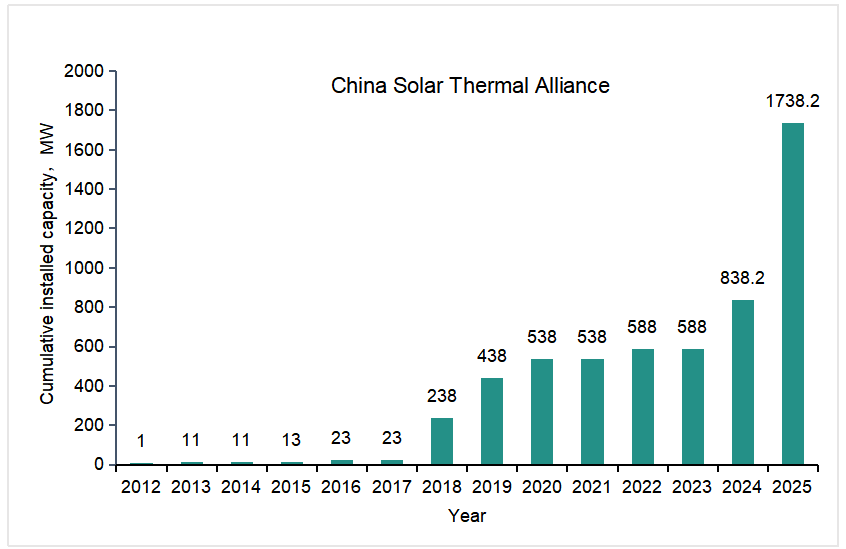
Figure: China's Cumulative Installed Capacity of CSP by 2025
According to statistics from the CSTA and the CSP Committee of the China Renewable Energy Society, approximately 25 solar thermal power projects were in the substantive construction phase, with a total installed capacity of 3000 MW. Notably, two 350 MW standalone solar thermal power plants commenced construction at the end of 2025. The number of planned and pending solar thermal power projects in China stood at around 31, with a total installed capacity of approximately 4050 MW (excluding projects with unspecified installed capacity).
According to the target set forth in the Several Opinions on Promoting the Large-scale Development of Solar Thermal Power Generation, by 2030, China's total installed capacity of solar thermal power generation is expected to reach around 15,000 MW. Assuming all planned and pending projects are implemented, an additional approximately 6000 MW of installed capacity will need to be developed and constructed in the next five years based on existing projects.
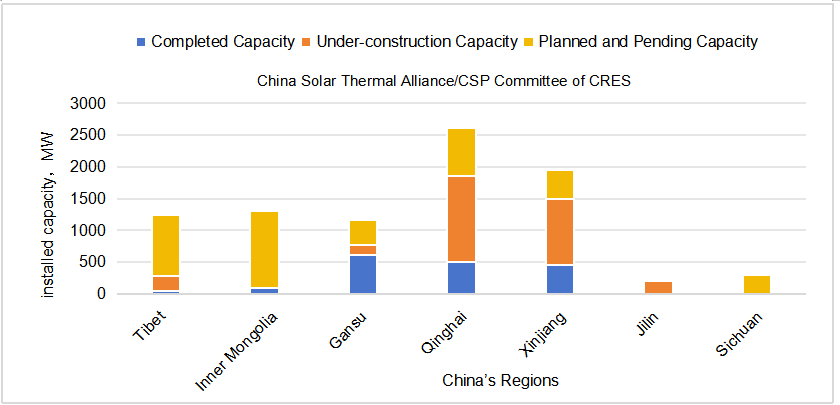
Figure: Expected Total Installed Capacity Based on all CSP projects in 2025 (Including Planned and Pending Projects)
Figure: Cumulative Installed Capacity of Completed Solar Thermal Power Generation Projects in China (as of 2025)
Figure: Distribution of Under-construction Solar Thermal Power Generation Projects in China
Regarding the construction of CSP plants across provinces and regions, Blue Book shows that by the end of 2025, Gansu Province had the largest cumulative installed capacity (621 MW, including the 1 MW rooftop linear Fresnel CSP system of Lanzhou Dacheng), followed by Qinghai Province (510 MW) and Xinjiang Uygur Autonomous Region (450 MW). Among under-construction projects, Qinghai Province led with the largest installed capacity under construction (1350 MW), followed by Xinjiang (1050 MW) and Tibet Autonomous Region (250 MW).
Based on public information and preliminary verification by the CSTA, Inner Mongolia Autonomous Region, Tibet Autonomous Region, and Qinghai Province ranked among the top in terms of planned and pending solar thermal power generation installed capacity, with a combined total of approximately 3000 MW.
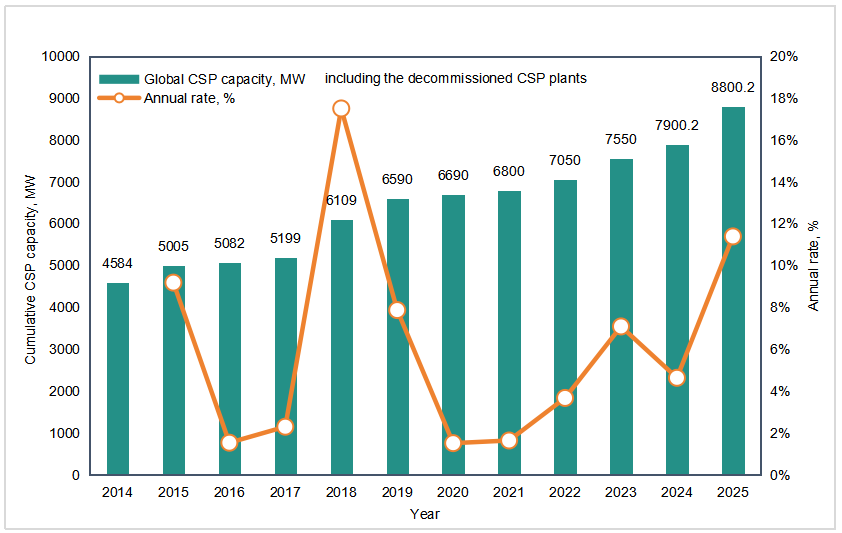
Figure: the cumulative installed capacity of CSP in major countries and regions worldwide reached 8800.2 MW (including 8 decommissioned trough power plants built in the United States in the 1980s), a year-on-year increase of 11.4%.
In terms of the market share of concentrating technologies, Blue Book shows that by the end of 2025, tower concentrating accounted for approximately 70.82% of China's cumulative installed solar thermal power capacity, followed by trough concentrating (10.93%), linear Fresnel concentrating (14.50%), secondary reflection concentrating (2.88%), Fresnel-like concentrating (0.86%), and supercritical carbon dioxide concentrating (0.01%).
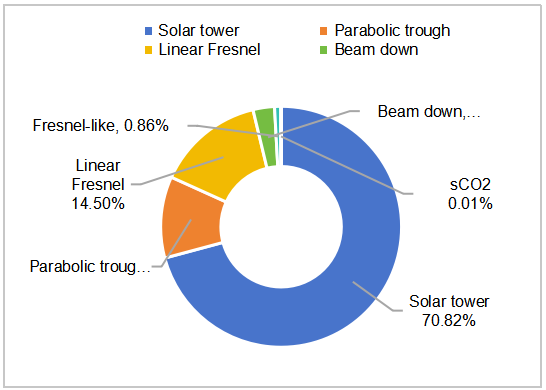
Figure: Market share of different concentrating technologies in China‘s cumulative installed capacity, by CSTA
In contrast, in major overseas countries and regions, trough concentrating dominated with a share of about 79.97%, followed by tower concentrating (17.28%) and linear Fresnel concentrating (2.75%).
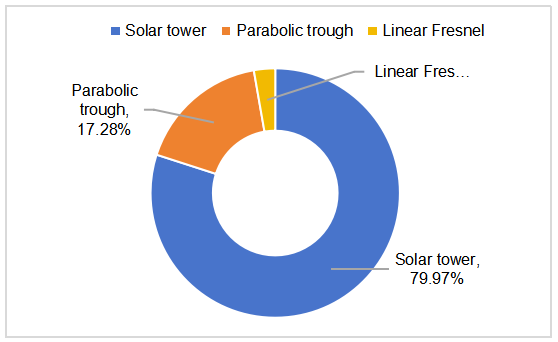
Figure: Market share of different concentrating technologies in overseas cumulative installed capacity, by CSTA
Regarding the operation of CSP demonstration projects, the Blue Book separately presents the technical parameters and annual operation data of the first batch of solar thermal power demonstration projects. Seven early-built solar thermal power plants achieved a total power generation of over 1.1789 billion kWh in 2025. The Luneng Golmud Multi-energy Complementary Project's 50 MW tower solar thermal power plant generated 148.2327 million kWh in 2025, a year-on-year increase of 55.92%. The CSSC New Energy Urad Middle Banner 100 MW trough solar thermal power plant achieved an annual power generation of 301 million kWh in 2025, representing an 8.27% increase compared to 2024. Both the CGN Delingha 50 MW trough solar thermal demonstration power plant and the Shouhang High-tech Dunhuang 100 MW tower solar thermal power plant hit record-high annual power generation in 2025, with a year-on-year increase of approximately 3.7%. The Qinghai Zhongkong Delingha 50 MW tower solar thermal power plant completed its annual power generation target for the fourth consecutive year. The Lanzhou Dacheng Dunhuang 50 MW linear Fresnel solar thermal power plant mainly focused on further upgrading its operation and maintenance strategies in 2025, resulting in a 13.6% increase in annual power generation. The PowerChina Gonghe 50 MW tower solar thermal power plant saw a 6.4% year-on-year growth in annual power generation in 2025. Due to unit overhauls conducted from September to October 2025, the PowerChina Hami 50 MW tower solar thermal power plant experienced an impact on power generation, with an annual output of approximately 102.99 million kWh in 2025.
In terms of the industrial chain and production capacity, based on inquiries using professional software that considered five key factors—enterprise name, business scope, company profile, brand products, and enterprise status—the Blue Book reveals that there are approximately 6,610,686 large, medium, small, and micro-sized enterprises involved in solar thermal power generation in China, including 10,722 state-owned enterprises, 533,771 private enterprises, 3,469 foreign-invested enterprises, and 458,861 micro-enterprises. Within the industrial chain, there are 36,884 manufacturing enterprises, among which 4,011 are general equipment manufacturers and 1,460 are special equipment manufacturers. In terms of manufacturing capacity, taking the production capacity of flat mirrors as an example, based on the requirement that "the mirror field area of a 100 MW power plant should not be less than 800,000 square meters in principle", the annual production capacity of major mirror manufacturers in China can support the construction of approximately 5,300 MW of solar thermal power plants.
In terms of technological R&D and achievement recognition, China launched 4 national key R&D program projects related to solar thermal power generation in 2025, with approximately 13 such projects under implementation during the year. Regarding standards, by the end of 2025, the International Electrotechnical Commission Technical Committee 117 (IEC/TC 117) had issued 11 international standards for solar thermal power generation. China currently has approximately 33 national standards in effect for solar thermal power generation, with 5 more in the drafting stage. In 2025, the National Energy Administration issued a total of 24 industry standard plans related to solar thermal power generation. By the end of 2025, the National Solar Thermal Industry Technology Innovation Strategic Alliance had released 22 alliance standards, including 14 standards specifically for solar thermal power generation. In 2025, several technological achievements related to solar thermal power generation participated in relevant award evaluations or were recognized by national authorities, with the number of awarded or recognized achievements increasing by approximately 71% compared to 2024.
Chapter 6 of the Blue Book elaborates on the techno-economic performance of solar thermal power generation. It shows that under the full power generation mode, the calculated levelized cost of electricity (LCOE) for parabolic trough, solar tower, and linear Fresnel CSP projects ranges from 0.426 CNY/kWh to 0.5323 CNY/kWh.
In terms of carbon emission reduction, the carbon footprint factor of solar thermal power generation was 0.0312 kgCO₂e/kWh in 2024, second only to nuclear power and hydropower. In 2025, the trading volume of Chinese Certified Emission Reductions (CCER) from grid-connected solar thermal power projects reached 1.0692 million tons, with a transaction value of 87 million CNY and an average transaction price of 81.58 CNY/ton (compared to an average transaction price of 69.27 CNY/ton for grid-connected offshore wind power projects).
The Blue Book indicates that through long-term operational verification, solar thermal power plants can achieve a maximum peak regulation rate of 10% per minute; existing projects have realized continuous operation for 230 days, with an annual equivalent full-load operation hour count reaching 3,300 hours. The Blue Book puts forward the following recommendations: expedite the research and formulation of a compensation mechanism for solar thermal power generation as a supporting power source; strengthen top-level design and planning guidance; fully summarize and evaluate the construction and operational experience of integrated solar thermal and photovoltaic projects; promote the large-scale and diversified development of solar thermal power generation in a classified manner; and accelerate technological and industrial innovation in solar thermal power generation.
The Blue Book consists of 9 chapters, including: Overview of Solar Thermal Power Generation Technologies, Market Development of Solar Thermal Power Generation, Operation of Solar Thermal Power Generation Demonstration Projects, Industrial Chain of Solar Thermal Power Generation, Technological R&D of Solar Thermal Power Generation, Techno-economic Performance of Solar Thermal Power Generation, Carbon Emission Reduction of Solar Thermal Power Generation, Development Recommendations for Solar Thermal Power Generation, and Appendices.
You can download the Chinese version of the Blue Book from the official website of the China Solar Thermal Alliance.